
By Dayne Hudson
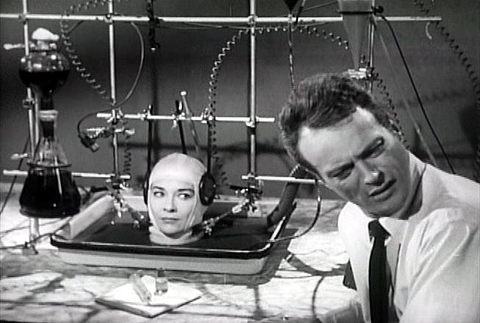
There's not much doctors can't do these days, and in 2 years time you might be able to add head transplants to the list!
There's many other transplants doctors have achieved, but now it seems even a human head isn't out of the question.
The idea is this: taking a head that's in working order from a body that no longer functions, and plonking it on a donor body...and it all working.
Sound like a hollywood film?
Well, maybe...
But aparently it's going to go from happening in a movie theatre, to an operating theatre!
A quick background - in the 1950's, Soviet scientist and organ transplant pioneer Vladimir Demikhov succsessfully transplanted dogs heads onto different bodies - you can watch see it for yourself at that link!
It's also been done with monkeys too.
But the issue in both experiments was the animals longevity; in both cases the animals didn't live long.
However, Italian surgeon Sergio Canavero believes he's worked out how to achieve a human head transplant, without an early death occuring as it did with the animals.
With the monkey, for example, the spinal cord of the transplanted head onto the body was never attempted.
The monkey was paralysed as a result from the neck down and needed artificial help to breathe.
Dr Canavero says the medical world is now wiser in this area now.
"I think we are now at a point when the technical aspects are all feasible," he told New Scientist.
His plan of attack is this:
1. Cool the transplant head and the donor body to slow cell death.
2. Cut the neck of both and link the major blood vessels linked with tubes.
3. Sever the spinal cords with the cleanest cut possible and join them with the tighly packed nerves inside.
4. Flush and inject the area with polyethylene glycol - which will allow the fat in cell membarnes to network.
5. Muscles, blood vessels and skin with be sewn together, and the patient would be placed into a coma for a number of weeks to prevent them moving. While they're asleep - electrodes would stimulate the spine with electricity to bolster the fresh nerve connections. And if there's a rejection from one of them, anti-rejection immunosupressants would be administered.
Dr Canavero says if the procedure was successful, then the patient could possibly be able to walk again within 12 months with the help of a physiotherapist.
Whilst it all sounds promising; it's yet to be tested.
Canavero plans on putting it to the test with brain-dead organ donors.
The technique will also be tested by Xiao-Ping Ren of Harbin Medical University in China, who recently conducted this successfully on a mouse!
And Dr Canavero knows it's not probably want everyone wants, but started talking about it years ago to see if it would gain momentum.
"If society doesn't want it, I won't do it. But if people don't want it in the US or Europe, that doesn't mean it won't be done somewhere else. I'm trying to go about this the right way, but before going to the moon, you want to make sure people will follow you."
I can asure you that if this is ever succsessful on a human being, we'll be one of the first to give you a "heads up!"


