
By Dayne Hudson

Talk to anyone who has succsessfully lost weight and they'll tell you the same thing.
It's all about satiety!
WHAT IS SATIETY?
For those who are unaware of what satiety is, it refers to your feeling of being full.
Obviously when you're fuller - you don't feel the need to eat.
So without the desire to consume calories, it's harder to put on weight.
And of course, there are a few pointers when it comes to satiety that can really help you lose weight!
FAT LOSS: SAVE CALORIES WITH SATIETY
One of the first steps is to think about your FIBRE intake.
Whilst we are all worried about hitting protein numbers, fat and carbohydrate numbers, FIBRE can also be important because of satiety.
Whilst the results are mixed, there is data suggesting that fibre intake can help (1).
HOW MUCH FIBRE DO I NEED PER DAY?
If you're not getting enough fibre everyday, with current recommendations being 25-38 grams (2), then do your best to reach those numbers.
It's very easy to NOT hit those numbers, so don't feel guilty if you can't!
If you struggle to eat it, consider a fibre supplement, but make sure it's not your only source of daily fibre intake.
PROTEIN FOR FAT LOSS AND SATIETY
Ah, one of the most important macronutrients of them all!
Protein won't only help you build muscle, but it's more satiating than carbohydrates or fat (3, 4-6).
The suggestion is that a rise in protein, at the cost of the other macronutrients, might promote satiety and assist with weight loss (7).
And it has been observed in a single meal (8-9) AND over a 24 hour period (10).
To get your protein numbers right - check this out here.
But it's pretty obvious isn't it - protein is vital for weight loss and satiety!
CARBOHYDRATES FOR FAT LOSS AND SATIETY
While celebrities and fitness "experts" tell you carbs are the devil, the truth is that they're quite a valuable aly in the war on body fat.
Most people will tell you that a food like potatoes are BAD for weight loss. They're a high GI carb, providing a large insulin spike, they'll tell you.
Well in research conducted into the satiety index (SI) of certain foods, potatoes have been found to have the best SI (11), despite secreting the most insulin (evident below).
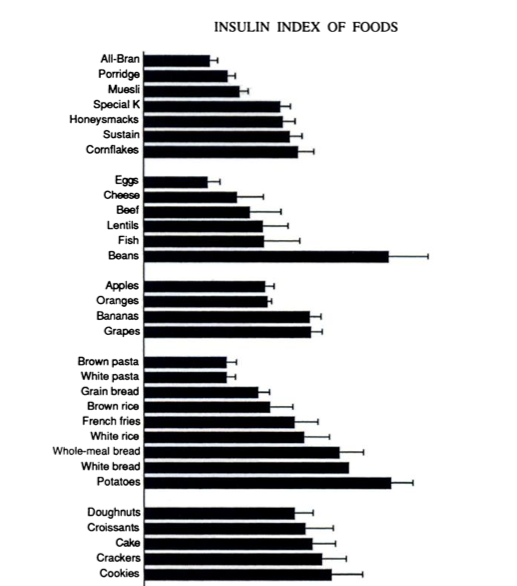
If there's article I've ever written I'd love you to read - it's this one: how flexible dieting and a higher carb intake than most "experts" say is BAD is actually NOT supported by science.
FAT LOSS: IT'S ALL ABOUT SATIETY TO REDUCE CALORIES TO LOSE WEIGHT
So there's 3 things to think about in regards to your diet for maintaining a good level of satiety; carbohydrates, protein and fibre.
Pay close attention to these and you'll be on the road to shedding the fat!
"Stay Fit, Stay Flexed!"
REFERENCES
(1) Clark MJ, Slavin JL. The effect of fiber on satiety and food intake: a systematic review. J Am Coll Nutr. 2013;32(3):200-11. doi: 10.1080/07315724.2013.791194.
(2) Slavin, J. (October 2008). "Position of the American Dietetic Association: health implications of dietary fiber". J Am Diet Assoc 108 (10): 1716–31. doi: 10.1016/j.jada.2008.08.007. PMID 18953766.
(3) Yancy WS Jr, Olsen MK, Guyton JR, Bakst RP, Westman EC. A low-carbohydrate, ketogenic diet versus a low-fat diet to treat obesity and hyperlipidemia: a randomized, controlled trial. Ann Intern Med 2004;140:769–77.
(4) Astrup A. The satiating power of protein—a key to obesity prevention? Am J Clin Nutr 2005;82:1–2.
(5) Westerterp-Plantenga MS, Rolland V, Wilson SA, Westerterp KR. Satiety related to 24 h diet-induced thermogenesis during high protein/carbohydrate vs high fat diets measured in a respiration chamber. Eur J Clin Nutr 1999;53:495–502.
(8) Blom WA, Lluch A, Stafleu A, et al. Effect of a high-protein breakfast on the postprandial ghrelin response. Am J Clin Nutr 2006;83:211–20.
(9) Latner JD, Schwartz M. The effects of a high-carbohydrate, high-protein or balanced lunch upon later food intake and hunger ratings. Appetite 1999;33:119–28.
(10) Lejeune MP, Westerterp KR, Adam TC, Luscombe-Marsh ND, Westerterp-Plantenga MS. Ghrelin and glucagon-like peptide 1 concentrations, 24-h satiety, and energy and substrate metabolism during a high-protein diet and measured in a respiration chamber. Am J Clin Nutr 2006;83:89–94.
(11) Holt SH, Miller JC, Petocz P, Farmakalidis E. A satiety index of common foods. Eur J Clin Nutr. 1995 Sep;49(9):675-90.


