
Normally, when something "new" comes along people are quick to shoot it down; it flies in the face of everything they thought they knew.
People (even those who claim to have credibility) are increasingly shooting down what appears to be a new craze, called IIFYM, which stands for "If it fits your macros" but was originally called flexible dieting.
But, alas, when a gimmick-esque acronym is attached to something people sit up and take note, especially when the word "diet" isn't mentioned for a change.
I've written about IIFYM before, how to implement it into your diet to ensure slow and steady fat loss without going way off the rails.
Visit that link if the nuts and bolts of how it will aid in fat loss is your primary goal, or read on if you want some of the popular questions into this explored.
Another thing to point out is that this new acronym is NOT a diet. It's not a fad, or something that will just disappear and be "debunked" if you will.
That is, because it's merely an APPROACH to eating that is BACKED by science that has long been known, but blown out of proportion by haters and people who don't endevour to do their own scientific research or worse yet, not open to giving something else a try.
WHAT THE HATERS SAY V'S WHAT'S ACTUALLY TRUE
Extremism in fitness never ends well.
Too far to either the right or the left of the scales isn't going to end well in most cases.
Those who misunderstand this concept seem to think that the craze is to completely STOP eating fruits vegetables and quality protein sources and chow down on fast food, cake, pop tarts, etc whilst staying in a calorie deficit.
Does this work?
Well...yes it does.
But am I, or anyone else seriously recommending this?
No.
However, we've seen evidence of this type of approach to weightloss before via the Twinky Professor in America along with other examples.
If you eating nothing but Twinkies yet stay in a calorie deficit - you'll lose weight (1).
Something that those with no real understanding of the insulin can't seem to fathom.
Insulin doesn't mean fat storage - it doesn't work like that.
Take a look at the graph below: (2)
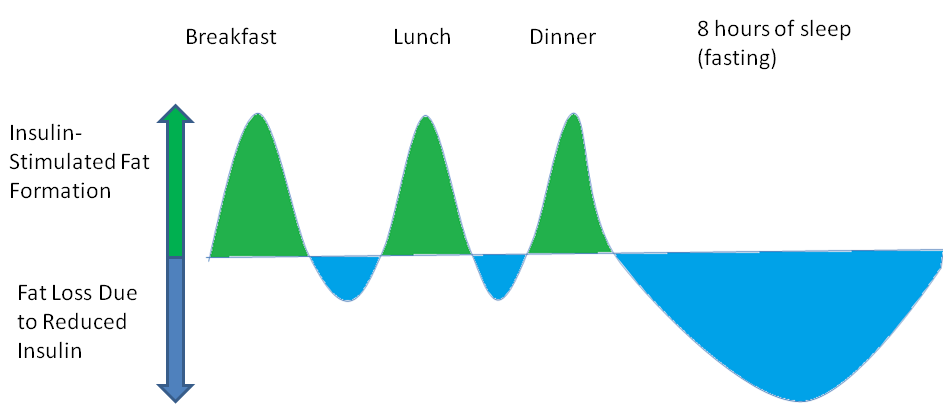
Yes, fat burning is switched off when we spike insulin.
But the minute it drops off (between eating and whilst we sleep) the fat is then lost.
Providing energy balance (calories in v calories out) is in a negetive state over 24 hours then our fat balance will be ZERO at the end of the day - REGARDLESS OF HOW HIGH OUR DIET IS IN CARBOHYDRATES! (2).
But people have taken this out of context to think that foods that trigger an all-mighty insulin release are bad.
Well they're wrong.
But this opinion isn't just restricted to ignorant fitness fanatics; the facebook post below is from a student studying nutrional medicine at a prominent University, who obviously hasn't been doing much studying at all:

Completely scientifically inaccurate.
Furthermore, insulin on the other hand actually supresses appetite (3).
So the bros throwing down the chicken and brocolli meal after meal after meal who think they're keeping insulin levels low and losing more body fat aren't achieving what they think they are.
After meals, fat is deposited with the help of insulin. However, between meals and during sleep, fat is lost.
Fat balance will be zero over a 24-hour period if energy intake matches energy expenditure (2).
Sugar/carbohydrates are not the enemy. And let me get even more pedantic (why not), carbohydrates actually have a greater thermogenic effect than fat - with 5-10% as opposed to fats that have just 2-3% (4).
Also, the bros think their chicken and brocolli meals aren't spiking insulin either, thus keeping fat loss at bay.
Well we have a huge problem here for these people (and the student)......
.....protein spikes insulin too (5).
So if insulin were the devil it's made out to be then we'd be storing fat constantly after every meal.
But clearly - we're not.
In fact, whey protein provides a higher insulin spike than white bread (6).
So how would something like white bread or anything equivalent cause waistline issues?
Not to mention those of us who train regulary (especially those who are endurance trained) need to worry EVEN LESS about GI, given training reduces GI of consumed foods too (7).
Let me reiterate - NO ONE is recommending you eat like the Twinky professor.
You're getting next to no protein (obviously required for growth and recovery whilst promoting antibodies for your immune system) and no micronutrients - important for recovery and for general health.
But the whole purporse of this approach, is to enjoy a combination of processed foods and wholefoods aka "clean" foods, with a small portion of your calories coming from the demonised processed foods.
And we're only just getting warmed up - click on the link below for the next stage.
PART 2 OF THIS ARTICLE: FAT LOSS HORMONES AND PROCESSED FOOD - WHY THERE'S NO DIFFERENCE
REFERENCES
(1) Park M. "Twinkie diet helps nutrition professor lose 27 pounds." CNN News. 2010 Nov 8.
(2) Kreiger J. Insulin...an undeserved bad reputation. Weightology weekly. 2010.
(3) Pliquett RU, Fuhrer D, Falk S, Zysset S, von Cramon DY, Stumvoll M. The effects of insulin on the central nervous system - focus on appetite regulation. Horm Metab Res. 2006 Jul;38(7):442-6.
Author

Dayne Hudson