
By Dayne Hudson
Science has proven many things about the health and fitness industry.
And unfortunetly for well-known TV doctor Dr Oz in the United States - science has found him to be dishonest and incorrect!
It comes as no surprise to many though, that have watched on in awe at some of his claims that are not backed by science.
And now we've got a study to back up these observations (1).
THE DR OZ STUDY
Investigators randomly looked at 40 episodes of The Dr Oz Show and The Doctors from early 2013, examining and evaluating all recommendations on every show.
Then - the research began!
A team of "experienced evidence reviewers" then set off to find scientific backing behind the 80 recommendations from the shows.
So what did they find? Let's hear from them:
"We could find at least a case study or better evidence to support 54% (95% confidence interval 47% to 62%) of the 160 recommendations (80 from each show). For recommendations in The Dr Oz Show, evidence supported 46%, contradicted 15%, and was not found for 39%. For recommendations in The Doctors, evidence supported 63%, contradicted 14%, and was not found for 24%. Believable or somewhat believable evidence supported 33% of the recommendations on The Dr Oz Show and 53% on The Doctors. On average, The Dr Oz Show had 12 recommendations per episode and The Doctors 11. The most common recommendation category on The Dr Oz Show was dietary advice (39%) and on The Doctors was to consult a healthcare provider (18%). A specific benefit was described for 43% and 41% of the recommendations made on the shows respectively. The magnitude of benefit was described for 17% of the recommendations on The Dr Oz Show and 11% on The Doctors."
Hmmm. Not what the doctor ordered....
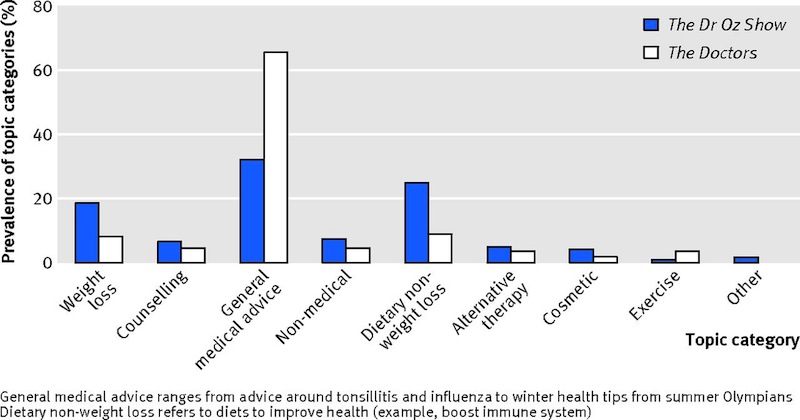
Below is a graph that highlights what topics were covered on both programs.
The researchers were forced to conclude that:
"Recommendations made on medical talk shows often lack adequate information on specific benefits or the magnitude of the effects of these benefits. Approximately half of the recommendations have either no evidence or are contradicted by the best available evidence."
Then for the big knife:
"The public should be skeptical about recommendations made on medical talk shows."
But even though it might all be inaccurate - people are still watching.
In the 2012-13 season, The Dr. Oz Show received an average of 2.9 million viewers every day, while The Doctors had 2.3 million watching.
But what to take from this study is pretty simple - accept what TV doctors say with a grain of salt and seek advice from a health care professional/doctor before making any health/weight loss decisions yourself, based on anything they tell you!
"Stay Fit, Stay Flexed!"
REFERENCES
(1) Korownyk C et al. Televised medical talk shows—what they recommend and the evidence to support their recommendations: a prospective observational study. BMJ 2014; 349. (Published 17 December 2014)Cite this as: BMJ 2014;349:g7346.


