
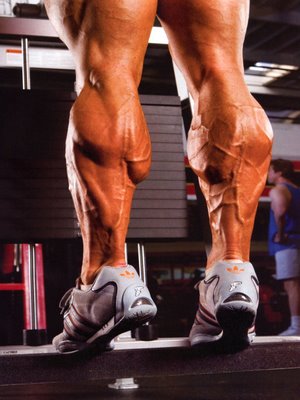
Admit it.
You walk into the gym with focused, determined and radiating swagger on chest day, arm day, and maybe others, too.
You're always looking for improvements there and those particular muscles are always trained at 100% intensity.
Then there's these litte things at the bottom of your legs, that are hardly ever on show, called calves.
They are at best, an afterthought.
When it comes to your muscle building workouts - these little babies are never really a priority.
And this, my friend, is one of the few reasons calves don't grow.
The intensity, dedication to muscle failure, and frequency is all off.
If I had a dollar for the times I've seen people train calves in the gym as hard as other muscle groups - I'd barely be able to attend a garage sale.
However, genetics, along with other factors do play a role too, but the point here is that if you don't push them hard enough, they won't grow.
THE CALVES
Let's dive into some calf anatomy.
Even though there are multiple muscles in the calves, we will focus on the gastrocnemius and the soleus - the muscles to develop if you want to have mean looking calves, or if your goal is just calf strengthening.
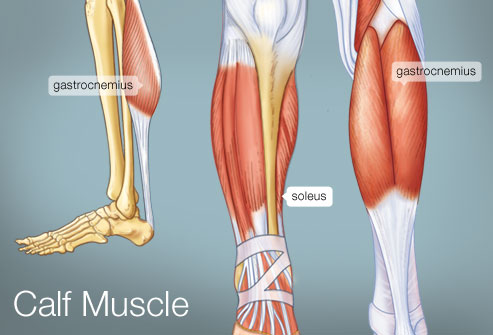
TRAINING BOTH THE GASTROCNEMIUS & SOLEUS
Training your calves with straight legs will work BOTH muscles.
This is the best for calf size, the best exercise to strengthen calves, and a MUST for any gym workout involving your calves.
However, the seated calf raise will predominatly work the soleus, due to the knee being bent.
Given the gastrocnemius crosses the knee, when it's bent, it can't put partake as much as the soleus does on this movement.
So, seated calf raises will really isolate the soleus.
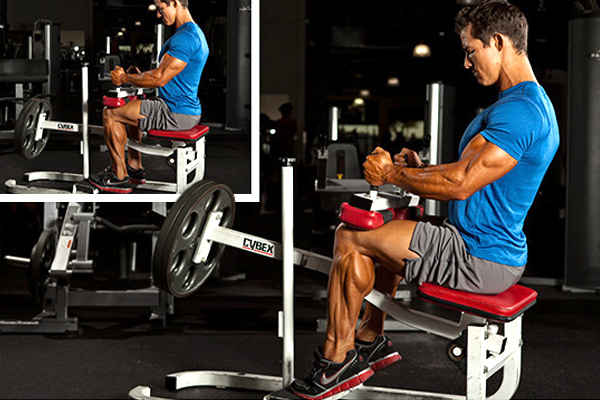
Seated calf raises - a decent calf machine, but aim mainly for the straight leg exercises.
THE RESEARCH
Exactly the fibre make-up (be it type 1 or 2) in the calves is certainly a debatable topic.
Though some are fixed on their opinions, research (1) into world-class shot putters has found a range between 13% and 67% slow twitch fibers (type 1) in the gastrocnemius, with an average of about 38% slow twitch fibers (type 2).
However, in untrained subjects, the avaiable data (2) tells us that the fibre distribution of the gastrocnemius in the average person, is usually 55-60% type I fibres and 40-45% type II fibres.
This is interesting, given many people will tell you that the calves are full of type 1 fibres predominently.
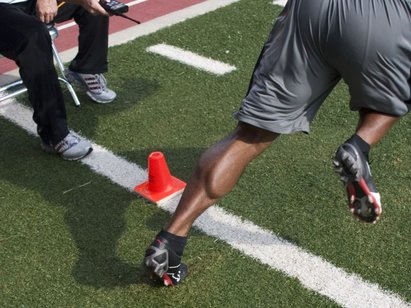
However, I'm therefore concluding, that although there MAY be a higher rate of type 2 fibres amongst the calves in people reading this, let's, for arguments and workouts sake, say it's 50/50.
I'll get to why later.
OTHER REASONS CALFS DON'T GROW
We've all got a variety of androgen receptors within our body. Some more - some less.
These receptors are latched onto by testosterone and other molecules, and stimulate protein synthesis.
Androgen receptors obviously play a large role in muscle growth.
Research (3) shows that there are a higher number of androgen receptors in the upper body than in the legs - which certainly DOES make it hard when it comes to growing your calves.
One of the reasons why many people have large upper bodies and small legs/calves.
But it's still NO excuse not to train them!
BUT I CAN LIFT SO MUCH WEIGHT ON CALFS - WHY DON'T THEY GROW?
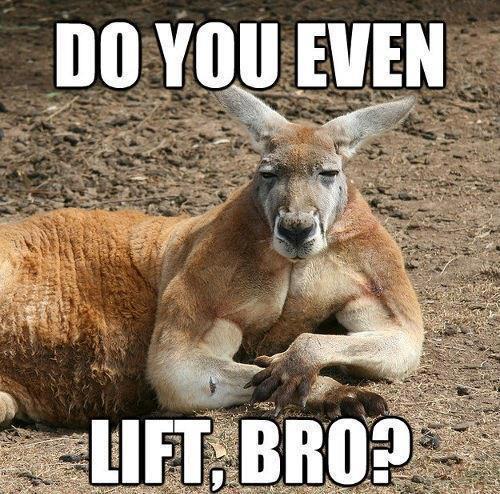
Research into animals, notably kangaroos, explains a lot of this (4).
To quote from the paper cited above:
"The muscles that power vertebrate locomotion are associated with springy tissues, both within muscle and in connective tissue elements such as tendons. These springs share in common the same simple action: they stretch and store elastic strain energy when force is applied to them and recoil to release energy when force decays."
So what does this mean?
Well, in the context of kangaroos, they hop for kilometres to cover large distances. They do so without experiencing any major muscle fatigue.
How? Because of their "springy tissues" such as their tendons.
They are able to load their tendons up with their body weight, which absorbs it, then releases the energy straight back.
So it's the tendons doing the work, and not the muscles.
And the same goes for human beings!
How many times have you seen somebody load the hell out of the calf raise, and bouce the weight, as oppose to lift it?
Well, the same thing is happening here.
The achilles tendon is absorbing the weight and bouncing it straight back, and the calves aren't doing a whole lot at all.
That's why, in the workout I'm going to give you, the quality of muscle contraction is going to be most important.
So you can see why calves really struggle to grow when:
- No one trains them as hard as chest or anything else (we WILL fix that)
- There aren't as many androgen receptors in the legs (can't really be fixed unless you take anabolic substances, which I DON'T advise)
- When they do, they let their achillies tendon absorb the work load (again, WILL be fixed)
So here's the moment you've been waiting for.
Close your eyes, hold onto your hats, take a sip of water, and get ready for the pain.
THE WORKOUT
For each rep, you will explode up and HOLD and SQUEEZE the contraction for roughly 1 second, before lowering it SLOWLY and exploding back up.
When you reach the point of failure - THEN you can start bouncing to get a few more reps out. But NOT before.
It's all about QUALITY of contraction here. We're aiming to use our calves predominantly - NOT our achilles tendon.
It's time to grow.
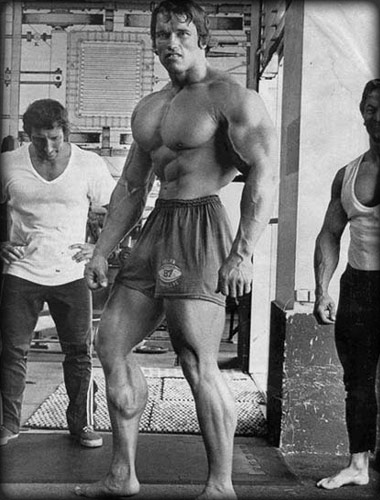
I mentioned earlier the 50/50 muscle fibre calf ratio, which justifies this torturous, painful, yet effective calf workout.
Given the general consensus resulting from current literature is that lower reps target type 2 fibres, and higher reps target type 1 fibres, a variety of rep ranges will be used.
Both of these circuits are giant sets - moving from one exercise to the next with limited to no rest!
REMEMBER: TRAIN TO MUSCLE FAILURE!
THE FIT'N'FLEXED CALF BUSTER
WARM UP: 3 x standing calf raise -15 reps
___________________________________________________
3 x standing calf raise - (weighted, 15-20 reps) [DON'T FORGET - QUALITY CONTRACTIONS AND NO BOUNCING UNTIL YOU REACH FAILURE!]
3 x step-up raises (on a step with bodyweight, 15-20 reps)
3 x plate raises (from a 20kg plate on the floor, toes on the edge of it, with bodyweight, 15-20 reps)
3 x raises from the floor (holding onto something GENTLY for support, bodyweight, 15-20 reps)
REPEAT THIS 3 TIMES
THEN DO:
3 x leg press raises (weighted, 8-10 reps)
3 x calf raises (weighted, 8-10 reps)
3 x one legged calf raise (body weight, standing on the base of a machine, hammer strength machines work well, 8-10 reps)
REPEAT THIS 3 TIMES
TIP: Try moving your feet outwards in inwards for ADDED intensity.
_____________________________________________________
Now you're training calves at the same intensity as everything else, with the CORRECT technique!
The longest I've been sore for after this workout is 6 days. Be prepared.
What you have there are some of the best exercises to strengthen your calves, and grow them too!
I promise it'll probably be the best calf workout you ever do!
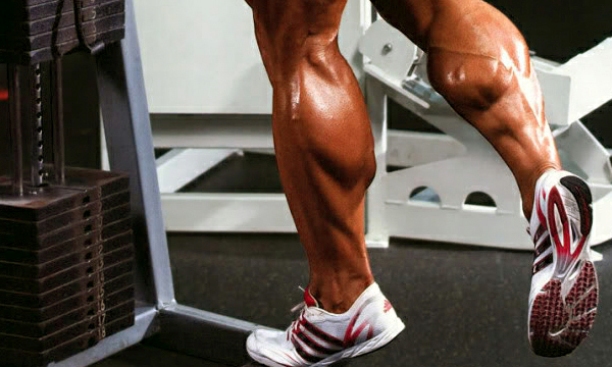
CONCLUSION
You hear people claiming that "calves don't grow - and they are a waste of time".
Well with that attitude - they never will. And that's most likely why they never do.
Yes, the idea of limited androgen receptors in our calves DOES in fact make it harder, but so does NOT training them properly with the correct INTENSITY, and in most cases, at all.
Embrace calf training. The above workout will push you extremly hard, but such intensity is a must for any serious calf training program.
I can honestly say that my calf workout (the above) is one of the hardest workouts I do all week.
I dare you to give it a try. Please tell me your thoughts!
Do it.
Stay Fit, Stay Flexed!
REFERENCES
(1) Coyle E.F., Bell S., Costill D.L., Fink W. (1978) Skeletal muscle fibre characteristics of world class shot-putters.Research Quarterly 49(3), 275-284.
(2) Coggan AR, Spina RJ, Rogers MA, King DS, Brown M, Nemeth PM, Holloszy JO. Histochemical and enzymatic comparison of the gastrocnemius muscle of young and elderly men and women. J Geront 1992; 47:B71-B76.
Author

Dayne Hudson